Invisalign Alternatives UK | Brands, Costs and Risks
Dentologi editorial team · 1 November 2026
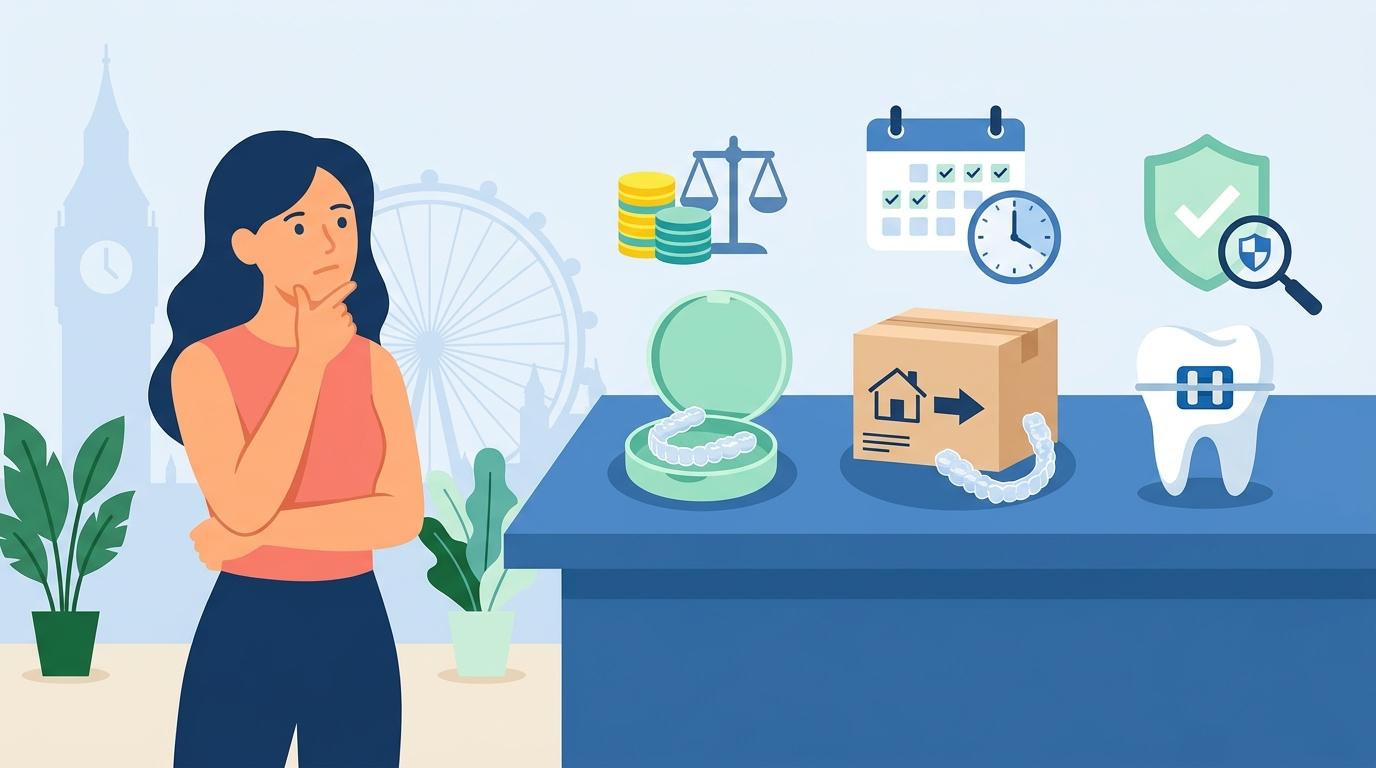
You want straighter teeth, you have seen the Invisalign quotes, and the number has made you pause. Perhaps a friend used a cheaper brand, or you have seen adverts for aligners posted to your door for a fraction of the price. It is natural to wonder whether the cheaper options do the same job, or whether you would be cutting a corner you later regret. Looking into Invisalign alternatives in the UK before you commit is a sensible step.
This guide compares the main Invisalign alternatives available in the UK: other in-clinic aligner brands, fixed braces, and at-home (mail-order) aligners. We set out typical price ranges, treatment times, what each option suits, and the safety points UK regulators have raised. At Dentologi we list NHS and private practices across the UK, and our aim here is to help you ask the right questions before you commit, whichever route you choose.
Invisalign Alternatives UK: Your Options Compared
- Why people look for Invisalign alternatives
- In-clinic clear aligner brands
- At-home aligners: cheaper, but what are the risks?
- Fixed braces as an alternative
- Side-by-side comparison of costs and timings
- What to know before you start
- How to choose the right option
- Mini FAQ
Why people look for Invisalign alternatives
Invisalign is the best-known clear aligner brand, and for many patients the name has become shorthand for "invisible braces". But it is one product among several. Clear aligners are a series of thin, removable plastic trays, each made to move your teeth a small distance. You swap to the next tray every week or two until your teeth reach the planned position.
The most common reasons people look elsewhere are:
- Cost. In-clinic Invisalign treatment in the UK often runs into several thousand pounds for a full case. We cover the detail in our Invisalign cost guide.
- A practice recommendation. Some dentists and orthodontists prefer a different aligner system, or use more than one.
- The type of problem. Some bites are better treated with fixed braces, or a combination of approaches.
- Convenience. Mail-order aligners promise fewer appointments, which appeals to busy adults.
The key point is that the brand matters less than the person planning and supervising your treatment. A well-planned case with a lesser-known aligner can work very well, and a poorly planned case with any brand can go wrong.
In-clinic clear aligner brands
In-clinic aligners are prescribed and monitored by a dentist or orthodontist. You have an examination before treatment, a digital scan of your teeth, and check-ups during treatment. This is the closest like-for-like alternative to Invisalign.
Popular Invisalign alternatives UK practices offer
Brands you are likely to come across in UK practices include:
- Spark (made by Ormco). Often described as using a clearer, more stain-resistant material. Practice prices are broadly similar to Invisalign.
- ClearCorrect (made by Straumann). Widely used, with options for minor and more comprehensive cases.
- Angel Aligner. A large international brand now offered by a growing number of UK practices.
- SureSmile Aligners (made by Dentsply Sirona). Often used by practices already working with that company's scanners.
- Smilelign and other UK-focused systems. Often aimed at cosmetic, front-teeth cases.
According to price comparisons by Dentistscloseby and Dentaly, typical UK ranges for these brands sit somewhere between about £1,800 and £5,000, depending on how complex your case is. Prices are set by each practice, not by the manufacturer, so the same brand can cost quite different amounts in different towns.
Is a different brand worse than Invisalign?
Not necessarily. All of these systems use the same basic idea: a digital plan, a series of trays, and small tooth-coloured bumps called attachments that help the trays grip and move teeth. Differences tend to be in the software, the plastic, and how much clinical experience your dentist has with that system.
Good questions to ask include:
- How many cases have you treated with this system?
- Do you plan the case yourself, or is it planned by the manufacturer's technicians and checked by you?
- Are refinements (extra trays if teeth do not track as planned) included in the price?
- Are retainers included, and for how long?
Short-term cosmetic aligner treatment
Many brands offer a "lite" or "express" option for minor crowding or spacing of the front teeth. These are cheaper and shorter, often a few months. They are aimed at the teeth you see when you smile and do not usually aim to change your bite. That can be perfectly reasonable if your bite is healthy, but ask your dentist what the treatment will and will not change.
At-home aligners: cheaper, but what are the risks?
At-home or "direct-to-consumer" aligners are sold online. You usually take impressions with a home kit or have a scan at a high-street site, then receive your trays by post. A dentist reviews your case remotely, and you send photos to check progress.
Typical prices
At-home aligners usually cost less than in-clinic treatment. Published ranges for UK at-home brands run from around £600 for a single arch to roughly £1,500 to £2,000 for both arches, according to Dentaly and Dentistscloseby. Some packages add whitening or retainers for an extra fee.
What UK regulators and professional bodies say
The General Dental Council (GDC) says remote orthodontic services are dentistry, so they must be provided by GDC-registered professionals. It also states that "there is no effective substitute for a physical, clinical examination" as the foundation for deciding on orthodontic treatment. In plain terms: someone should look at your teeth and gums in person before your teeth are moved.
The risks of skipping that step include:
- Undiagnosed gum disease or decay. Moving teeth supported by unhealthy gums can make bone loss worse.
- Bite problems. Straightening the front teeth without checking how your teeth meet can create new problems.
- Limited help if things go wrong. If teeth do not move as planned, you may need to pay a local dentist to sort it out.
The collapse of SmileDirectClub, one of the biggest mail-order brands, showed what can happen when a provider disappears. It filed for bankruptcy in October 2023 and shut down in December 2023, leaving some UK patients mid-treatment. At the time the British Orthodontic Society described the exit as "nothing short of scandalous", and the British Dental Association called for stronger regulation, as reported by Dentistry.co.uk.
Can at-home aligners ever be a reasonable choice?
For some adults with very mild crowding or spacing, healthy gums and a stable bite, an at-home system may produce a result they are happy with. The safer approach, if you are tempted, is to have a check-up with your own dentist first, including X-rays if needed, and to ask them whether your case is simple enough. Also check the name and GDC registration of the dentist responsible for your treatment, and confirm you can speak to them directly. You can check any dentist's registration on the GDC's online register.
Fixed braces as an alternative
It is easy to forget that the oldest alternative to Invisalign is often the most effective. Fixed braces are brackets bonded to your teeth and joined by a wire. Modern options include:
- Metal braces. The most affordable fixed option and very effective for complex cases.
- Ceramic (clear or tooth-coloured) braces. Less visible than metal, usually a little more expensive.
- Lingual braces. Fitted behind the teeth so they cannot be seen from the front. Usually the most expensive option.
Aligners or braces: which works better?
Both work. A 2019 study in BMC Oral Health comparing the two found that both corrected misaligned teeth effectively. Aligners did well with moving teeth in segments and had shorter treatment times in that study, while fixed braces were better at achieving good contact between upper and lower teeth and controlling root position.
The British Orthodontic Society says aligners suit mild to moderate problems that can be treated without extractions, while severe crowding, cases needing extractions, or jaw discrepancies may need fixed braces. Our guide to adult braces in the UK covers fixed options in more detail.
Can I get braces on the NHS as an adult?
Usually not. The NHS says braces are usually only free for under-18s who have a clinical need. Adults generally pay privately. Clear aligners for cosmetic reasons are a private treatment.
Side-by-side comparison of costs and timings
The table below gives typical UK ranges drawn from published practice and comparison data. Prices vary by practice, region and case complexity, so treat these as a starting point for conversations, not a quote.
| Option | Typical UK price range | Typical treatment time | Best suited to |
|---|---|---|---|
| Invisalign (in-clinic) | £1,500 to £5,500 | A few months to 2 years | Mild to moderate cases, some complex cases with an experienced clinician |
| Other in-clinic aligners (Spark, ClearCorrect, Angel, SureSmile) | £1,800 to £5,000 | A few months to 2 years | Similar to Invisalign, depending on the clinician |
| Short cosmetic aligner courses | £1,500 to £2,500 | Around 2 to 6 months | Minor front-teeth crowding or gaps |
| At-home aligners | £600 to £2,000 | Around 4 to 12 months | Very mild cases only, ideally after an in-person check |
| Metal fixed braces | £1,500 to £4,000 | 12 to 24 months | Most cases, including complex ones |
| Ceramic or lingual braces | £2,500 to £8,000+ | 12 to 24 months | Complex cases where appearance matters |
Remember to factor in extras that are not always included in the headline price:
- Initial consultation and scans
- X-rays and a hygiene appointment before you start
- Refinement trays
- Retainers (and replacements later on)
- Composite bonding or whitening at the end, if you want it
Many practices offer interest-free or low-interest finance to spread the cost. A dental plan will not usually cover orthodontics for adults, but it may help with the check-ups and hygiene visits around treatment. See our comparison of dental plans and dental insurance.
What to know before you start
Whatever brand or type you choose, the start of treatment should look broadly the same. Only a dentist or orthodontist can decide whether a particular treatment is right for you, after examining you in person.
Who clear aligners suit
Clear aligners tend to suit adults who:
- Have mild to moderate crowding, spacing or relapse after childhood braces
- Have healthy teeth and gums
- Can wear the trays for most of the day, usually around 20 to 22 hours, and take them out only to eat, drink anything other than water, and clean their teeth
- Are prepared to wear retainers long term afterwards
When aligners may not be the best choice
Aligners may be less suitable, or need extra steps, if you have:
- Active gum disease or untreated decay
- Severe crowding or a case needing extractions
- Significant bite or jaw problems
- Many crowns, bridges or implants, which may limit how teeth can move
- Difficulty wearing the trays consistently
Possible side effects
Most people find aligners comfortable, but common effects include:
- Pressure or soreness for a day or two after each new tray
- A slight lisp for the first few days
- Rough edges that can rub the tongue or cheeks
- Higher risk of decay if you drink sugary drinks with trays in or do not clean well
What the dentist checks first
Before any straightening, a responsible clinician will usually:
- Carry out a full check-up of your teeth, gums and existing fillings
- Take X-rays to check roots and bone levels
- Treat any decay or gum problems first
- Take a 3D scan and photos to plan the movements
- Explain what the treatment can and cannot achieve, and what retainers you will need
Retention is part of the treatment, not an optional extra. The British Orthodontic Society is clear that retainers are needed to stop teeth moving back. Our guide to retainers after braces explains the options.
How to choose the right option
Here is a practical five-step approach to comparing Invisalign alternatives in the UK.
- Start with a check-up. Ask your usual dentist, NHS or private, whether your teeth and gums are healthy enough for straightening, and what kind of problem you have. This costs far less than putting right a poorly planned treatment.
- Get two or three consultations. Include at least one specialist orthodontist if your case may be more than mild. Ask each one which systems they would use for you, and why.
- Compare like with like. Ask for a written quote that lists scans, X-rays, number of trays or refinements, check-ups, retainers and aftercare. A cheaper headline price can hide extras.
- Check who is responsible. Confirm the name and GDC registration of the clinician planning and supervising your treatment, and how you contact them if a tray breaks or teeth stop tracking.
- Plan for retention. Ask what retainers are included, how often they need replacing, and what that costs. Factor this into your budget from day one.
Our checklist on how to choose a cosmetic dentist has more questions to take to your consultation.
If you are not sure whether you need aligners, braces, bonding or something else, you can use Fix My Smile. Tell us what bothers you about your smile, and we will pass your enquiry to suitable practices so you can compare options without pressure.
Mini FAQ
What is the cheapest Invisalign alternative in the UK?
At-home aligners usually have the lowest headline price, but they carry more risk and suit only very mild cases. Among in-clinic options, metal fixed braces or a short cosmetic aligner course can cost less than full Invisalign. The cheapest option overall is the one that suits your case and does not need correcting later.
Are Invisalign alternatives in the UK as good as Invisalign?
Many in-clinic aligner brands can give similar results for suitable cases. The experience of the dentist or orthodontist planning and monitoring the treatment usually matters more than the brand name.
Can I switch brands halfway through treatment?
It is possible but not simple. A new clinician will need to reassess your teeth, take new scans and create a new plan, which usually means paying for a new course of treatment. It is better to choose carefully at the start.
Do I still need to see my dentist during aligner treatment?
Yes. Regular check-ups and hygiene visits remain important, because aligners can trap plaque against your teeth. Keep your usual dental appointments throughout treatment.
Conclusion
There are good Invisalign alternatives in the UK, from other in-clinic aligner brands to modern fixed braces, and for some very mild cases even at-home systems. The right choice depends less on the logo on the box and more on a proper in-person examination, a clear plan, honest pricing and a commitment to wearing retainers afterwards. Take your time, ask questions, and get more than one opinion before you commit.
Sources