Dental Implant vs Bridge | Costs, Lifespan and Choice
Dentologi editorial team · 5 November 2026
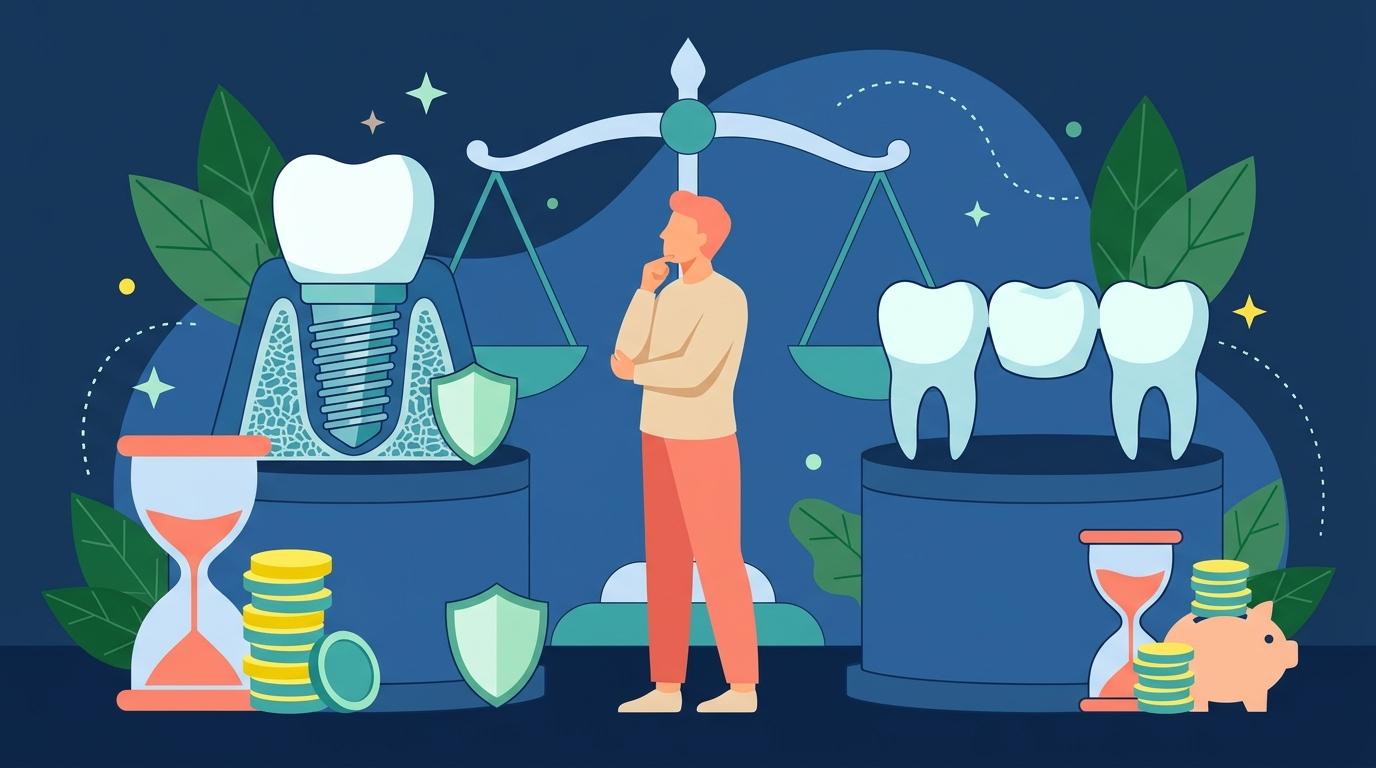
If you have lost a tooth, or have been told one needs to come out, the choice between a dental implant vs bridge can feel like a big decision with a big price tag. You may be worried about the cost, about how many appointments it will take, about whether surgery will hurt, or about spending thousands of pounds on something that might not last. Those are fair concerns, and the answer is rarely the same for two people.
This guide sets out how implants and bridges work, what each typically costs in the UK on the NHS and privately, how long the evidence suggests they last, and who each one suits. It also covers the checks a dentist will make first and the questions worth asking before you agree to a plan. At Dentologi we do not treat patients; we help you find NHS and private practices, so our aim here is simply to help you go into that conversation well informed.
Dental Implant vs Bridge: Which Is Right for You?
- How implants and bridges work
- Dental implant vs bridge cost in the UK
- How long do they last?
- Pros and cons side by side
- What to know before you start
- How to choose: five practical steps
- Mini FAQ
How implants and bridges work
Both options replace a missing tooth with a fixed false tooth that you do not take out at night. The key difference is what holds the new tooth in place.
What is a dental implant?
An implant is a small titanium post placed into the jawbone where the root of the missing tooth used to be. Over a few months the bone heals around it, and a connector (called an abutment) and a crown are then fitted on top. The Oral Health Foundation describes the usual sequence as consultation and assessment, placement of the post, a healing period of around four months, then fitting of the crown, bridge or denture. In some cases a tooth can be fitted on the same day, but your implant dentist will tell you whether that is suitable.
Because an implant stands on its own, the teeth either side of the gap are left alone.
What is a dental bridge?
A bridge is a false tooth held in place by the natural teeth next to the gap. The NHS describes it as "a fixed replacement for a missing tooth or teeth", usually made of metal and porcelain. There are a few main designs:
- Conventional (fixed) bridge: the neighbouring teeth are shaped and crowned, and the false tooth is joined between those crowns. This means drilling down teeth that may be healthy.
- Adhesive (resin-bonded or "Maryland") bridge: a false tooth with small metal or ceramic "wings" bonded to the back of the neighbouring teeth. It needs little or no drilling and is often used for front teeth.
- Cantilever bridge: supported from one side only, used in selected cases.
- Implant-supported bridge: two or more implants hold a bridge spanning several missing teeth. This is really a type of implant treatment.
The Oral Health Foundation notes that a bridge generally needs strong, healthy neighbouring teeth and good support from the bone and gums, and that after an extraction the gums usually need around six months to heal before a bridge is fitted.
Dental implant vs bridge cost in the UK
Cost is usually the deciding factor, so it helps to look at NHS and private fees separately. Prices vary by practice and region, and the figures below are guides, not quotes.
Dental implant vs bridge on the NHS
Bridges are available on the NHS where clinically needed. In England they fall under Band 3, which the NHS band guide confirms includes "a fixed replacement for a missing tooth or teeth (bridge)". According to the NHS Business Services Authority, the Band 3 charge in England from 1 April 2026 is £332.10, and that one charge covers all the Band 3 work in a single course of treatment. Charges in Scotland, Wales and Northern Ireland are set differently. You can read more in our guide to NHS dental charges in 2026.
Implants are a different story. The NHS says implants are usually private and costly, and are only sometimes available on the NHS for people who cannot wear dentures for particular reasons, such as after mouth cancer or an accident. Hospital services such as Guy's and St Thomas' treat referred patients, but most adults who simply want an implant to replace a lost tooth will pay privately.
Private fees compared
Private bridges are often priced per "unit", meaning per tooth in the bridge. A conventional bridge replacing one tooth has three units: two crowns and the false tooth in the middle. As an example, Bupa Dental Care Cottingham lists a porcelain-bonded bridge from £1,277 per unit, which shows how a three-unit bridge at some practices can cost more than a single implant. Other practices charge much less.
For implants, published "from" prices for a single implant with its crown commonly start around £2,800 to £3,000. Tower Dental quotes from £2,800 including the abutment and crown, and Dental Implants London quotes from £2,950 including the crown, with bone grafting from £495 if needed. See our full breakdown of dental implants cost in the UK for more detail.
| Option | NHS (England) | Typical private range | Typical treatment time |
|---|---|---|---|
| Adhesive (resin-bonded) bridge | Band 3, £332.10 if clinically needed | Roughly £500 to £1,200+ | 2 to 3 visits over a few weeks |
| Conventional bridge (3 units) | Band 3, £332.10 if clinically needed | Roughly £1,200 to £4,000+ | 2 to 3 visits over a few weeks |
| Single implant with crown | Rarely available; hospital referral only | Roughly £2,500 to £3,500+, plus any grafting | Usually 3 to 12 months |
| Implant-supported bridge | Rarely available | Often £4,000 to £12,000+ | Usually 3 to 12 months |
Private ranges are drawn from published UK practice price lists and guides, including All Health and Care's bridge guide. Your own quote depends on materials, laboratory fees, scans, and any work needed first, such as an extraction or gum treatment.
Hidden costs to ask about
When comparing quotes, check whether each one includes:
- The consultation, X-rays and any 3D (CBCT) scan
- Extraction of the old tooth, if it is still there
- Bone grafting or a sinus lift for implants
- A temporary tooth while you heal
- Review appointments and any warranty
- Hygienist visits, which matter for both options
Many practices offer finance or a dental plan that can spread or reduce costs. Read the terms carefully, and do not let a monthly figure rush your decision.
How long do they last?
Neither option is permanent, and nobody can promise how long yours will last. Research does, however, give a useful picture of average performance.
- Single implants: a 2012 systematic review of studies with at least five years of follow-up found that about 97% of implants supporting single crowns survived at five years and about 95% at ten years. The crowns on top survived slightly less often (around 89% at ten years), as they can chip or need replacing.
- Conventional bridges: a 2015 systematic review in Dental Materials estimated five-year survival of around 94% for metal-ceramic bridges, with all-ceramic designs slightly lower.
- Adhesive bridges: a 2017 review in Clinical Oral Implants Research reported survival of around 91% at five years and 83% at ten years. The Sussex Community NHS Foundation Trust says most last about seven to eight years before coming unstuck, and many can then be re-bonded.
In practice, how long either lasts depends heavily on your cleaning at home, your gum health, whether you grind your teeth, whether you smoke, and how often you see your dental team.
What can go wrong with each?
With a bridge, the main risks are decay or gum disease around the supporting teeth, the bridge coming loose, and, for conventional bridges, the supporting teeth needing root canal treatment later because they have been prepared for crowns. If a supporting tooth fails, the whole bridge may need replacing.
With an implant, the main long-term risk is peri-implantitis, an infection of the gum and bone around the implant caused by plaque build-up. The Oral Health Foundation lists red or swollen gums, bleeding, infection and loosening as possible signs. Guy's and St Thomas' also notes that an implant may fail to fuse with the bone, a risk that is higher in smokers.
Pros and cons side by side
Dental implant pros and cons
Pros
- Leaves the neighbouring teeth untouched
- Strong long-term survival in research studies
- Feels and is cleaned much like a natural tooth
- Can help keep the jawbone in that area loaded and stable
Cons
- Higher upfront cost and rarely available on the NHS
- Involves minor surgery and a healing period of several months
- Needs enough healthy bone, or grafting first
- Not suitable for everyone, for example some people with uncontrolled medical conditions
Bridge pros and cons
Pros
- Usually quicker, often finished in a few weeks
- No surgery
- Available on the NHS under Band 3 where clinically needed
- Adhesive bridges need little or no drilling
Cons
- Conventional bridges mean cutting down neighbouring teeth, which is permanent
- Harder to clean under the false tooth; you will need special floss or small brushes
- Depends on the health of the supporting teeth
- Adhesive bridges can come unstuck
| Factor | Implant | Bridge |
|---|---|---|
| Effect on neighbouring teeth | None | Crowned (conventional) or bonded to (adhesive) |
| Surgery | Yes, usually under local anaesthetic | No |
| Time to finish | Months | Weeks |
| NHS availability | Rare | Yes, where clinically needed |
| Cleaning | Brush and clean between like a natural tooth | Extra cleaning under the false tooth |
Remember there are other choices too: a removable partial denture is often the lowest-cost option, and for some gaps, leaving the space is reasonable. Our guide to dentures cost in the UK covers that route.
What to know before you start
Only a dentist, or a specialist such as a prosthodontist or oral surgeon, can tell you whether an implant or a bridge is right for you after examining your mouth. What follows is general information to help you prepare.
Who each option tends to suit
An implant may suit you if the teeth next to the gap are healthy and unrestored, your gums are healthy, you have enough bone (or are willing to have grafting), and you can wait several months for the final tooth.
A bridge may suit you if the neighbouring teeth already have large fillings or crowns (so preparing them costs little extra tooth), you want a quicker result, you would prefer to avoid surgery, or you want an NHS option.
Contraindications and risk factors
Your dentist will want to know about anything that could affect healing or long-term success, including:
- Smoking or vaping, which raises the risk of implant problems; Guy's and St Thomas' strongly recommends stopping
- Active gum disease, which should be treated before either option
- Diabetes and other medical conditions, especially if not well controlled
- Certain medicines, such as some bone-strengthening drugs or blood thinners
- Tooth grinding (bruxism), which can damage crowns and bridges
- Age and growth: implants are generally not placed until the jaw has stopped growing
What the dentist checks first
Expect a full check-up, X-rays of the area, an assessment of your gums and of the neighbouring teeth, and, for implants, often a 3D scan to measure the bone. The Oral Health Foundation recommends asking for a written treatment plan and a clear cost estimate before treatment starts.
Side effects and recovery
After implant surgery, some swelling, bruising and tenderness for a few days is common, and you may need soft foods for a short time. After a bridge is fitted, teeth that have been prepared can feel sensitive to hot and cold for a while. Your dentist will give you aftercare instructions; contact the practice if pain or swelling gets worse rather than better.
How to choose: five practical steps
- Get a proper assessment. Book a check-up with X-rays so you know the health of the neighbouring teeth, your gums and your bone. If you do not have a dentist, you can find a dentist near you.
- Ask about all the options. Ask the dentist to explain an implant, a bridge, a denture and leaving the gap, with the pros, cons and likely lifespan of each for your mouth specifically.
- Get written, itemised quotes. Make sure each quote lists scans, grafting, temporary teeth and reviews, so you are comparing like with like. Our crown cost guide helps you understand per-unit bridge pricing.
- Check the clinician's experience. Ask how many implants or bridges they place each year, what happens if something fails, and whether there is a warranty. Our checklist on choosing a cosmetic dentist applies to restorative work too.
- Think about the long term. Factor in hygiene visits, possible replacement of a crown or bridge, and how you will keep the area clean. Be cautious about very cheap deals abroad; our article on Turkey teeth explains why aftercare matters.
If you are not sure what you need, our Fix My Smile tool lets you describe your situation and passes your enquiry to suitable practices, so you can get advice without committing to anything.
Mini FAQ
Is a dental implant better than a bridge?
Neither is better for everyone. Implants protect the neighbouring teeth and show strong long-term survival in research, but they cost more, involve surgery and take months. A bridge is quicker and cheaper and available on the NHS, but it relies on the neighbouring teeth. The right choice depends on your teeth, gums, bone, health and budget.
Can I get a dental implant vs bridge on the NHS?
A bridge, yes, if your dentist agrees it is clinically needed; in England it is part of the £332.10 Band 3 charge. Implants are rarely available on the NHS and are usually limited to people referred to hospital for specific reasons, such as after cancer treatment or an accident.
Does getting an implant hurt?
The procedure is usually done under local anaesthetic, so you should feel pressure rather than pain. Some soreness and swelling afterwards is common for a few days. If you are anxious, ask about sedation; our guide to dental sedation explains the options.
Can a bridge be replaced with an implant later?
Often yes, if there is enough bone where the tooth is missing. However, the neighbouring teeth will already have been prepared for a conventional bridge, and they will still need crowns. An adhesive bridge keeps more options open because it involves little or no drilling.
Conclusion
When weighing up a dental implant vs bridge, the honest answer is that both can work well. An implant usually costs more and takes longer but leaves your other teeth alone; a bridge is quicker, cheaper and available on the NHS, but it depends on the teeth either side. The best next step is a thorough assessment and clear, itemised quotes, so you can decide with your dentist rather than on price alone.
Sources